
Updated
What's real and what's simulated
Every price is real history. Only your orders — and how they fill — are simulated.
Think of the desk as a flight simulator built from real black-box recordings. The weather, the turbulence, the runway — all recorded from the actual day. Only your hands on the controls are new.
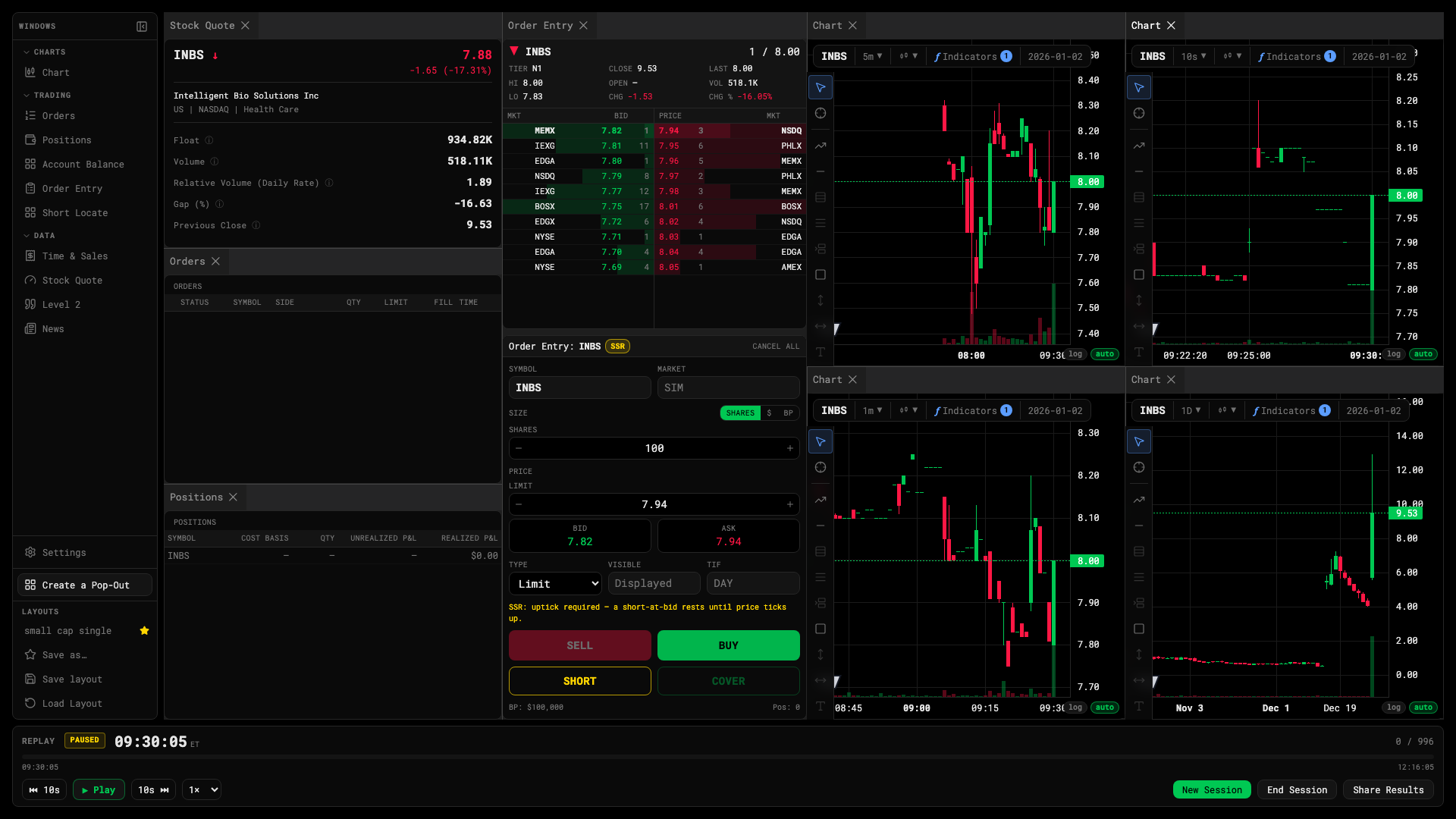
- Window catalog
- Chart
- Order entry
- Transport
Real
- Every quote and every print. NBBO updates, bid/ask sizes, trade prints and their condition codes come from tick-level historical data for that ticker on that date.
- Scanner alerts. Top Leading Gainers and High-of-Day Momentum hits fire at the exact timestamps they fired live, in the same order.
- News. Headlines appear as the replay clock passes their publish time.
- Fundamentals. Float and shares outstanding as of the replay date, from SEC filings, with splits applied.
- The clock. Every timestamp on the desk is the replay clock, never your wall clock.
Simulated
- Your orders. They never leave the building. No real capital moves.
- How they fill. A fill engine evaluates each order against the real NBBO with a drawn latency, walk-the-book mechanics for marketable orders, and queue position for resting limits. See Reading a fill.
- Your account. Cash, buying power, P&L — all tracked, none real.
Deterministic
Same ticker, same date, same start time, same seed → the same tape, the same alerts, and the same latency draws. You can replay a day as many times as you want and compare your decisions, not the dice.
Was this article helpful?
Related articles
- Reading a fill and its slippageThree NBBO snapshots, a latency draw and a slippage breakdown on every fill.
- Latency profilesChoose how far away your broker is — and how much every order costs in time.
- Create your account and sign inSign up with an email, confirm it, set a password, and land on the desk.